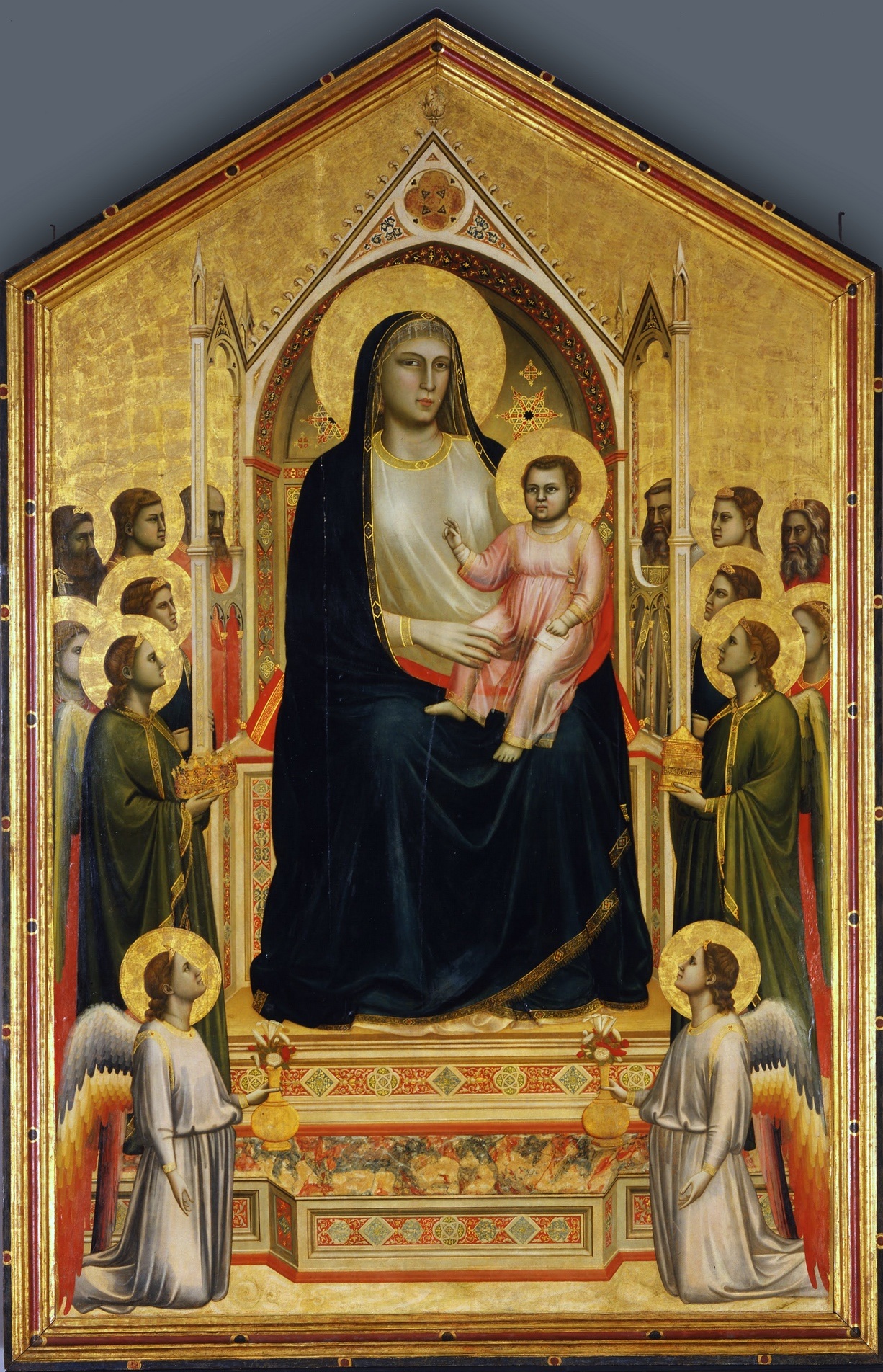
Whether you believe in God or not you can't deny the importance of religion in society. Athiests being a minority, a large percentage of the world's population belongs and has belong throughout history to some form of religion or spiritual community. This is evident in the cultures across the world and the effect this has had on art throughout art history is tremendous.
Early Art
Saying the phrase "early religious art" would be rather redundant. It seems in much of early art history we see the majority of artistic expression involving some religious theme in one way or another. Cave paintings often depicted rituals and ceremonies. Even if it seems only wild animals running or a hunt, it is very possible the paintings themselves were meant as a sort of prayer for good luck to supply the people with meat.
Before alphabets were even invented, symbols and images of the air god and other deities decorated the buildings of ancient Mesopotamia. People from this earliest of civilizations believed in a higher power and held rituals for important events such as burials, and began to record their beliefs. Places of worship were erected to pay homage to their many gods. These temples would be important examples of architecture in the culture of ancient Mesopotamia as would the temples and houses of worship of every other culture through the ages to this day.
Temples were an important part of the indigenous peoples of the Americas such as the Mayans, Incas, and Aztecs. They believed in human sacrifice and would have stepped temples where the person would be offered to the god on top, closest to the sky. We know about the religions of these societies by studying their writing systems, which consisted of hieroglyphs. These hieroglyphs were a series of symbols painted on ceramics, or carved in wood, stone, or molded in stucco.
In the Eastern hemisphere, art history is mostly dominated by Buddhist beliefs and thus Buddhist art. Starting around 1 A.D. in the Indian subcontinent, Buddhism would influence much of the culture of the whole of Asia and prevail for centuries. Buddha was mostly represented in sculpture and sometimes bas-reliefs. These Buddhas can be pre or post-enlightenment. The pre-enlightenment Buddhas have a whole subcategory called "Bodhisattvas." These beings were on the way to enlightenment and offered support for others on their journey.
Medieval And Renaissance Art
The art of the Middle Ages is dominated by religion. The majority of paintings are mostly Christia-themed, representing stories mostly taken from the bible. The Church knew that most of the uneducated masses couldn't read, so paintings were meant as a way for the peasantry and illiterate to learn the ways of God. These paintings and frescoes were painted all over churches and public walls and portrayed the lives of the saints, Jesus Christ with the Mother of God, and the Holy Spirit, as well as many other biblical passages.
Some of the finest pieces of architecture in European history belong to the magnificent cathedrals and churches that dot the landscape. In cities throughout the world, such as Philadelphia, there seems to be a church on every corner housing a plethora of different religions dating from all periods of time, some centuries old. Indeed these building structures were meant to last, with some cathedrals having about as much stone beneath the surface as was above. It is no surprise people took refuge in the old churches in time of war. The styles and attributes of these cathedrals with their arches, steeples, and flying buttresses are the subject of a much more detailed article to come in the future.
The people of the Middle Ages in general were a highly religious bunch. Christianity had a stronghold on most of the European countries and the priest and bishops were the highest ranking public officials. With plagues and other hardships, as well as basic philosophical unrest it was easy for the religious leaders to control the masses with promises of damnation or salvation. A tithe of 10% of one's income ensured favor with the priest, thus buying favor of the saints. For a small fee one can reduce the time in purgatory of a recently deceased loved one. It is no surprise that the cardinals and popes of centuries ago as well as today are grandly dressed with gold jewelry and worshiping with fine holy instruments of precious metals.
Prayers were offered in the form of icons. Small art objects were made which were meant as an offering to God. To this day icons are n important part of religious art, ranging from modern crucifixes to tabernacles and chalices. To the people who pray and have prayed to these icons, the object is not a mere work of art, but rather a sacred object with a very special function. The making of these icons was a delicate task undertaken usually by a monk. Strict rules and guidelines had to be adhered to in order to make the object holy. The immaculate surface was painstakingly painted and was the equivalent to the writing of scriptures.
Throughout the Renaissance of the late Middle Ages, much of the early religious art stayed the same. Churches were built extravagantly in accordance to modern styles, and Christian art was still sacred and served a purpose for more than just viewing. But around this time, private patrons were beginning to commission and purchase art for themselves. Guilds of painters became artisans to serve the public, rather than just the Church and government. This meant subjects were beginning to stem away from dominant religious themes and the art was much more free. Religious themed art began to see the patrons themselves painted right alongside the saints or even the Holy Family. With advances such as the understanding of perspective, as well as the emergence of landscape paintings for their own sake, art in general started to become more diverse.
Some religious themes took on a more secular spin to them as well. Sculptors such as Michelangelo created artworks such as the biblical David but made them in a more realistic way rather than the usual religious practice of portraying people ideally. Caravaggio's holy themes with simple humble looking subjects took the religious art world at storm. Portraying the Virgin Mary alongside peasants with dirt on their feet was a bit much for the traditional Catholics. But times were changing.
Religious Art of Modern Times
Wassily Kandinsky the Russian abstract painter stressed the importance of spirituality in art. His book, Concerning The Spiritual In Art tells us how spiritual life is like a large triangle with the point being occupied by only those who "bring sublime bread to man." He says the artist has the task and mission of bringing others to the top through the use of his talent. During bad times, he says, souls fall to the bottom of the pyramid and seek only material success, and ignore the spiritual. Kandinsky goes on to explain some of the psychology involved in observing a painting. When we look at colors, he says, two things happen. One is a physical reaction to the colors which may bring us joy comparable to eating a tasty treat. The other is a spiritual vibrating of the soul.
Many contemporary artists still produce religious art in traditional ways. God or gods and important scriptural stories are portrayed as they always were. Much religious art of today is kitschy, with statues of saints and Blessed Virgin Marys being produced by the gross for the religious masses to consume. People wear jewelry such as crosses and other examples of religious artifacts that they probably take for granted.
Religion in general has inspired, and will continue to inspire, artists to express their beliefs as offerings or homages to a higher spiritual world, or as messages meant to influence, inspirit, or educate society at large.

No comments:
Post a Comment