Ever see a painting where you thought you could just reach out and grab something out of it? Some paintings are so lifelike, look so real, it's hard to tell yourself you're looking at a canvas when you're brain is sure it's looking at a real situation.
This is called Trompe l'oeil. It's a French phrase meaning "to fool the eye," and involves painting in such high detail that the finished product is an optical illusion, making the viewer think the painting is really three dimensional.
Tricks of perspective are used and crafty painting is employed to make something look real. You might see a piece of paper seem as if it is stuck to a surface, or a fly appear to have landed on the painting. Sometimes the subject of the painting even comes out of the frame! No matter what it is, it is sure to look very realistic.
The photorealists of the 1960s, and the recent hyperrealist painters know Trompe l'oeil all too well, but the perspectival illusion technique has been around since antiquity. It is found in ancient Greek and Roman murals, where you might find a doorway painted on a wall, intended to show a larger room beyond. Advances in understanding perspective opened a new door for illusion painting, and artist playfully used Trompe l'oeil to achieve all kinds of affects to trick the spectator.
Ceiling Illusions
A whole genre in Trompe l'oeil is dedicated to creating illusions in ceilings. Sotto in su is the Italian term meaning "seen from below" and makes the viewer see real perspective in the painting, as if the surface is actually a receding area. A person below could look up at a flat ceiling and perceive a dome. Further yet, the dome could have an opening and beyond a vast blue sky showing us a beautiful day, rain or shine in reality.
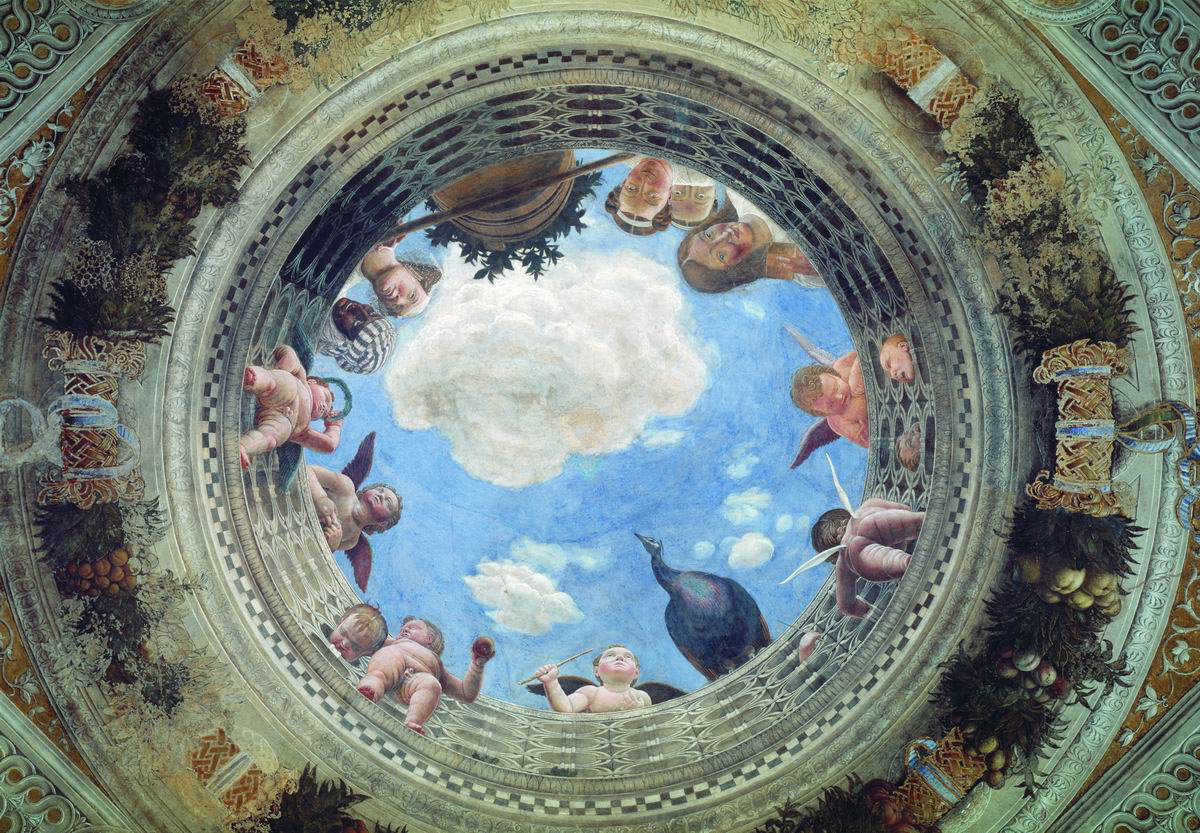
Seen above is the ceiling of the Camera degli Sposi painted by Italian painter Andrea Mantegna in 1473. This is probably the first known use of Sotto in su and a fantastic example of the style. It was painted for his patron, the Duke of Mantua, and all across the walls are depicted scenes from the Duke's life.
Visitors to this reception room would look up to see the illusion on an oculus, or round opening. Clever use of foreshortening allows us to look up and beyond the ceiling into the sky. Several women of the court are seen peering down into the room below while cherubim playfully cling to the railing. It's a good thing they have wings, because it looks as if any moment they could slip. Also on the ledge is a pot with a small tree in it, which seems to be supported in part by a pole going across- not very sturdy. A peacock perches and watches the whole scene. This painted oculus was no doubt the most popular item in the whole room.
Trompe l'oeil has always fooled and amused everybody who has come across it. There's a story of two Ancient Greek painters in a contest. One produced a painting so real birds flew down and attempted to eat the grapes in the picture. Laughing, he told the other he couldn't win now, and just remove the curtains to see his painting. But it turns out the curtains were the painting, and the first painter promptly conceded defeat. Another story is of George Washington entering a room and bowing down to a person at the far end coming down a staircase, only to realize it was only a painting.
Trompe l'oeil- I can't believe it's not real!

No comments:
Post a Comment